Full of Grace: Transform the World with God's Love.
Each year we are guided by the wisdom that springs from our spiritual theme. We share a similar theme with Marist Schools across Australia.
Tony Clarke, Director of Marist Mission and Life Formation explains the 2026 theme in this way:
“What if the world’s peace and flourishing began not with grand gestures, but a humble yes?
Grace is that yes. It is God’s love, freely given, undeserved, unmeasured, and without conditions. It is offered to everyone. When we receive it, something begins to change within us, reshaping our actions, our capacity to love and how we engage with the world.
Grace, like love, is always a gift. Once accepted, it overflows from our hearts and radiates outward, moving us to share God’s love with others. Grace is not abstract or distant; it is the living presence of God in the ordinary: a word of encouragement, listening with patience, a hand extended in peace. In these small acts, God’s love moves through us, shaping us into instruments of grace.
Mary shows us what this looks like. When the angel greets her: “Hail, full of grace, the Lord is with you” (Luke 1:28), her yes was not timid or passive. It was bold and courageous. Her trust let God’s love shape her life, her choices, her relationships and her very being. That yes changed everything.
So what about us? What does saying yes look like today?
We live in a world that longs for peace and understanding, where fear and division can often overshadow hope. Yet grace shows us another way. It invites us to be bridge-builders where there are walls, to show understanding where there is judgement and to choose love even when it feels easier to walk away. Grace is God’s love in action: listening deeply, serving humbly, washing feet, kneeling in honour of the dignity of others and rising with the conviction to stand for those who are powerless.
The challenge stands before us:
What kind of community are we becoming?
Are we willing to love beyond comfort, to forgive beyond fairness, to serve without counting the cost?
Who will we walk with and what will we stand for?
Today, the question is simple and profound: Will our yes be bold? Will it be courageous?
This is not easy work, but it is holy work; the work that feeds our hearts and souls. Abbot Jamison captures its power beautifully:
“Grace is God’s way of restoring our trust in the goodness of life. The relationship between goodness and grace can perhaps be understood by analogy with food. If food is nourishing, then it’s considered to be full of goodness. Similarly, grace is a goodness that nourishes the soul; it feeds the good in us so that we can trust each other and flourish together.” (Abbot Christopher Jamison OSB, Finding the Language of Grace. 2022. Bloomsbury Publishing.)
Through grace, our yes becomes nourishment, not only for ourselves, but for the world.
At his inauguration Mass, Pope Leo XIV reminded us:
“Now is the hour of love. The heart of the Gospel is the love of God that makes us brothers and sisters. We are called to offer God’s love to everyone …” (Homily of Pope Leo XIV at Inauguration Mass, 18 May 2025.)
He went on to stress:
“Our world, wounded by war, violence and injustice, needs to hear the Gospel message of God’s love and to experience the reconciling power of Christ’s grace.” (Address by Pope Leo XIV to the General Assembly of the Pontifical Mission Societies, 22 May 2025.)
Let us be that message. Be that grace. Now is the hour. Transform the world with God’s love.”
Image Reflection
In the image of Jesus kneeling to wash the feet of his disciples, we encounter grace in its most tangible form. God’s love in action. This moment, quiet yet revolutionary, reveals the heart of the theme Full of Grace – Transform the World with God’s Love. It is not a display of power or grandeur, but of humility, presence and service.
The artwork comes from a series of icons titled The Way of the Family by Australian artist and iconographer Sue Orchison. In this image Washing of the Feet, “Jesus is servant; He humbles himself and asks us to do the same.”
Jesus, “full of grace and truth” (John 1:14), chooses not to command but to kneel. He does not seek recognition but offers tender service. In this act, grace becomes visible: undeserved, unmeasured, freely given. It is a love that lowers itself to lift others up, a love that transforms.
This image invites us to reflect on our own “yes” to grace. Like Mary, whose bold and courageous yes allowed God’s love to shape her life, we are called to echo that yes in our own time. In a world aching for peace, where division and fear often speak louder than hope, grace whispers another way. It asks us to kneel, to listen, to serve.
Let this image be our challenge and our inspiration. Let it remind us that grace is not abstract, it is the touch of God in the ordinary. And when we receive it, live it, and become it, we do more than reflect God’s love, we transform the world with it.
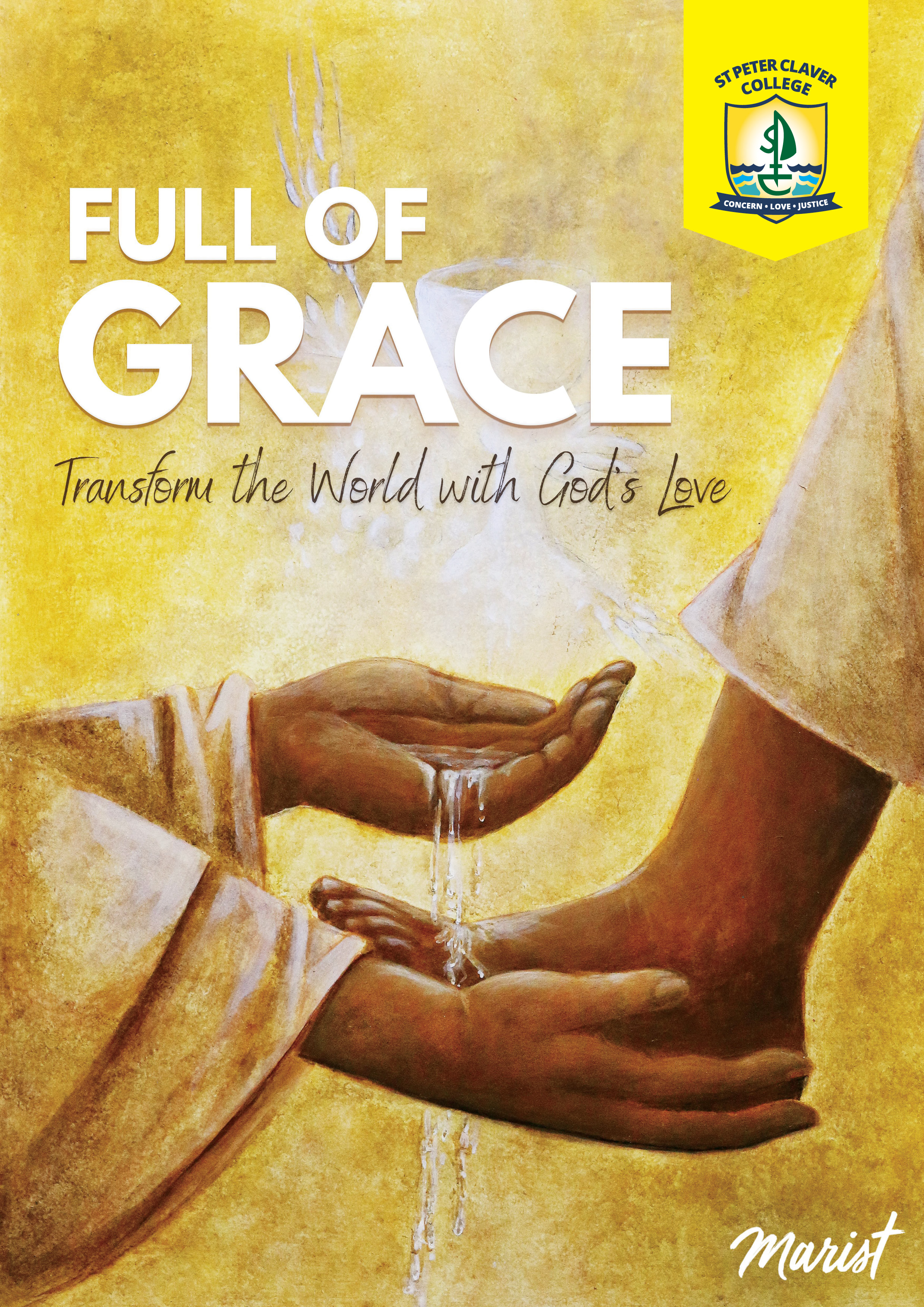
© The Marist Association of St Marcellin Champagnat (2026).